
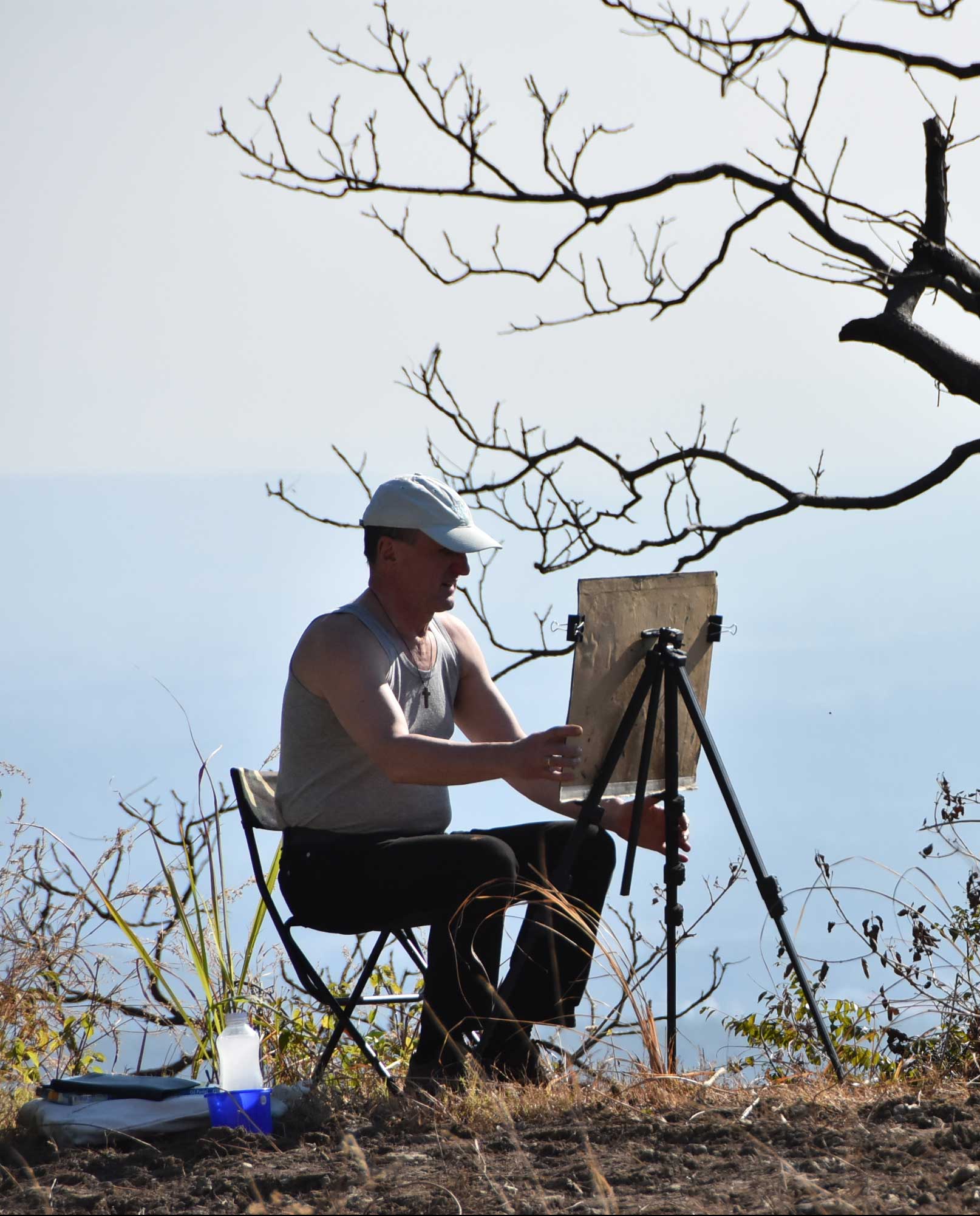
Today we conclude a week-long journey with international plein air artists at Kaaya. Plein air painting means leaving the studio behind to paint and draw directly in the open air — and at a time when both climate and humanitarian crises loom large, these artists left the comfort of home to pick up brushes, paints, and easels in search of something the studio couldn’t offer them.
Day one: arrival
Long journeys take their toll, and what you need at the end is somewhere warm to settle. Arriving at Kaaya late in the evening is, for most, a small shock — minimal lighting, rough terrain, mud-earth cottages without central heating. The rural reality asserts itself quickly. And yet, amid the adjustment, there’s an unmistakable burst of fresh air, of being somewhere genuinely different. That was the response we witnessed as fifteen artists arrived across four vehicles.
Day two: exploring and communicating
In the cold, asking residents if they slept well is a tricky question at Kaaya — most nights are cold, and most mornings are honest about it. But the morning itself was something else entirely: smoke rising from the huts, birdsong, the particular sense that time had slowed enough for city rhythms to start loosening their grip.
From early morning, the artists explored the village and its surroundings — partly on foot, partly by vehicle, scouting locations to return to later with canvas and easel. By afternoon, Tilwari, Birsani, and Jagatpur had each found themselves hosting visitors unlike any they’d seen — strangers stationed quietly along the road or in a field, doing something the village had never quite watched before.
Language wasn’t always necessary. Art spoke for itself often enough that when one artist, Nataliya, lost her way exploring, local youth simply brought her back — pleased enough with the encounter to ask for a photograph.
For the socio-cultural dimension of the programme, Oksana — who teaches at a university in Cuttack, originally from Russia and living in India for eleven years — joined as a bridge between groups. Conversations around the evening bonfire turned to opportunities for Indian artists to study in Russia, to questions of heritage and education, to what binds people across very different starting points.
Day three: bridging and bonding
The third morning took the group toward the Bhadraj valley, through Dhalani and Koti village, chasing the particular light of sunrise and sunset — each sitting requiring roughly three hours of uninterrupted, almost meditative work. Watching the artists set up, position themselves, and work without break highlighted a level of dedication that needed no translation.
It also gave the group — a mix of Indian and international artists — time to understand how central Kaaya itself had been to their being brought together at all. The thread traced back to Jagmohan Bangani, an artist and friend whose own residency at Kaaya years earlier had been inspiring enough to invite others. What began as an informal gathering, with no pressure to produce signature work, slowly became something more — a community of artists who realised they didn’t need to wait for a sponsor to do something meaningful together.
It was Satya, one of the earlier participating artists, who first suggested Kaaya as a destination for Art-Eco 2019–20 — an idea that took further shape through his conversations in Russia with Shreyanshi of Shryansi International, who joined this residency herself, alongside the St. Petersburg Centre for Humanitarian Programmes led by Vitaliy.
To be continued.
Leave a Reply